






A Complete Beginner’s Guide to Proprietary Trading
Estimated reading time: 0 minutes
Introduction
Did you know you can trade with a firm’s simulated capital and keep up to 100% of the profits? That’s what proprietary trading (or prop trading) is all about!
Many traders dream of trading full-time but struggle with capital limitations and risk exposure. Prop firms solve this by funding skilled traders in a simulated environment, allowing them to earn without risking their personal funds.
In this Prop Trading 101 guide, we’ll break down: ✔ What prop trading is and how it works ✔ How to get funded by a prop trading firm ✔ The best strategies for passing a prop firm challenge ✔ Pros and cons of prop trading vs. retail trading ✔ The best prop trading firms to get started with ✔ The importance of trust when choosing a prop firm
Table of contents
Let’s dive in! 👇
What is Prop Trading?
Definition of Prop Trading
Proprietary trading (prop trading) refers to trading financial assets using a firm’s simulated capital instead of client or personal funds. These firms provide simulated funding to traders who pass an evaluation process and meet risk management criteria.
How Prop Trading Works
- Traders sign up for a prop firm challenge to prove their skills.
- If they pass, they receive a simulated funded account to trade with.
- They earn a profit split (up to 100% with some firms like Funded Trading Plus).
- The firm makes money by sharing profits and charging fees for challenges.
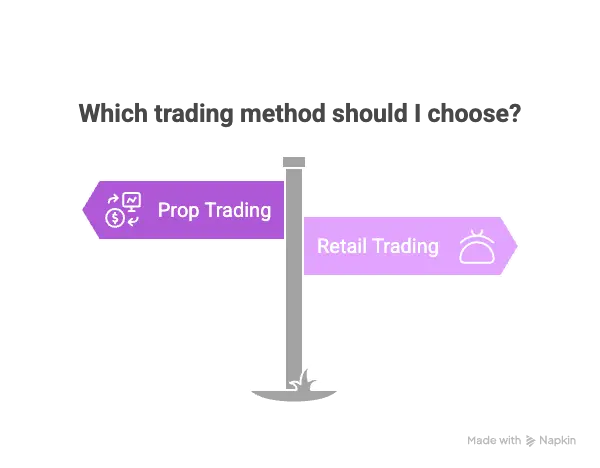
Prop Trading vs. Retail Trading
| Feature | Prop Trading | Retail Trading |
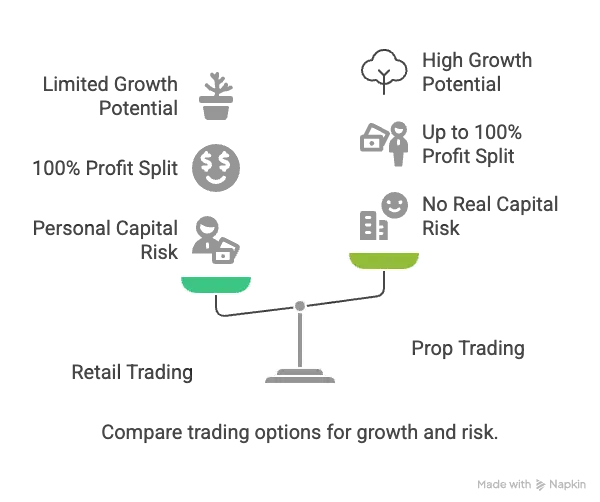
| Risk | No real capital risk | Trader risks personal money |
| Profit Split | Up to 100% to trader | 100% to trader |
| Growth Potential | Can scale up to $2.5M | Limited by personal capital |
| Capital | Firm provides simulated capital | Trader uses personal funds |
| Trading Rules | Must follow firm’s risk limits | Broker Limitations |
Prop trading is ideal for skilled traders who lack capital but want to scale their trading career in a simulated environment!
Top Prop Trading Firms in 2025
| Feature | Funded Trading Plus | Funded Next | FTMO |
| Evaluation Time Limits | None | Minimum Trading Days (Varies by Plan) | None |
| First Withdrawal | Day 0 | 21 Days | 14 Days |
| Scaling Plan | Every 10% Profit (No Time Limit) | Available | Requires 4 Months, 10% Profit, 2 Payouts |
| Profit Split | Up to 100% | Up to 95% | Up to 90% |
| Minimum Withdrawal | $50 | 10% | $50 |
How Prop Trading Firms Work
The Business Model of a Prop Firm
- Funding Traders: Firms provide simulated capital to traders who prove their skills.
- Profit Splits: Traders keep 50-100% of their profits (Funded Trading Plus offers 100% profit share!).
- Evaluation Fees: Traders pay a one-time fee to take an evaluation challenge.
- Scaling Plans: Profitable traders get increased simulated capital over time.
How to Get Funded by a Prop Firm
1️⃣ Sign up for a Prop Firm Challenge (e.g., FTMO, Funded Trading Plus)
2️⃣ Trade within the rules (e.g., max drawdown, profit target)
3️⃣ Pass the Evaluation and receive a simulated funded account
4️⃣ Trade Live and withdraw profits based on the firm’s payout rules
📌 Unlike hedge funds, prop trading firms do not provide real capital but rather a simulated trading environment, allowing traders to prove their skills while earning real profits.
Pros and Cons of Prop Trading
✅ Advantages of Prop Trading
✔ No personal capital risk – Trade with the firm’s simulated money ✔ Access to large trading accounts – Up to $2.5M simulated funding ✔ Keep up to 100% of profits – Funded Trading Plus offers full profit retention ✔ Flexible trading strategies – Many firms allow forex, stocks, crypto, indices
❌ Disadvantages of Prop Trading
❌ Strict risk management rules – Max drawdown, daily loss limits ❌ Profit split (varies by firm) – Some firms only offer 50-80%, while Funded Trading Plus allows 100% ❌ Challenge fees – Most firms charge an upfront fee for evaluation
📌 If you’re disciplined and skilled, prop trading can be an excellent way to trade with significant simulated capital!
Best Strategies for Prop Trading Success
📈 1. Trend Following Strategy
- Use moving averages (50 & 200 EMA) to identify trends
- Look for higher highs & higher lows in uptrends
- Set a stop loss below key support levels
📉 2. Breakout Trading Strategy
- Identify consolidation zones
- Place buy orders above resistance & sell orders below support
- Use stop losses to minimize risk
🔄 3. Mean Reversion Trading
- Look for overbought/oversold conditions using RSI or Bollinger Bands
- Trade reversals back to the mean
📌 Each prop firm has different rules, so choose a strategy that aligns with their risk management policies!
How to Choose the Right Prop Trading Firm
What to Look for in a Prop Firm
✔ Profit Split: Best firms offer 80-100% profit share
✔ Funding Amount: Look for firms with scalable accounts
✔ Trading Rules: Avoid firms with unrealistic restrictions
✔ Payout Speed: Choose firms with fast & reliable withdrawals
📌 Funded Trading Plus is one of the few firms offering 100% profit share, making it a top choice for traders!
Why Trust Matters When Choosing a Prop Firm
The Role of Trust in Prop Trading
The rise of prop trading has also led to an increase in questionable firms that impose hidden fees, unrealistic rules, and delayed payouts. Choosing a trustworthy firm is critical to your success as a prop trader.
Why Independent Review Sources Matter
Many review sites are paid to feature specific firms, making their rankings biased. Instead, traders should rely on independent sources like TrustPilot, Reddit, and trading forums where real traders share their experiences.
Key Indicators of a Trustworthy Prop Firm:
✔ Transparent Fees & Rules: Clear challenge fees, withdrawal conditions, and risk management rules.
✔ Verified Payouts: Look for proof of real traders receiving payouts.
✔ Positive Reviews on Independent Platforms: TrustPilot ratings and active trader feedback.
✔ Fair Trading Conditions: No unrealistic daily loss limits or forced closures.
📌 Always research a firm thoroughly before committing to a challenge. A firm with genuine trader reviews and a proven track record is far more reliable than one with paid rankings on review sites.
📢 Conclusion & Next Steps
Prop trading is a game-changer for traders who want to trade with significant simulated capital while minimizing personal risk. However, choosing a reputable prop firm is just as important as mastering trading strategies.
Before selecting a prop firm, always verify its legitimacy through independent sources like TrustPilot and real trader communities. With the right firm and discipline, prop trading can be an incredible opportunity for aspiring traders.
🚀 Ready to get started? Choose a reputable prop firm and take your trading career to the next level!
🔥 Ready to Start Your Prop Trading Journey?
🚀 Join Funded Trading Plus today and start trading with up to $2.5M in simulated capital – and keep 100% of your profits!
Prop Trading 101 – Frequently Asked Questions
Prop trading, or proprietary trading, is when a firm uses its own capital to trade financial markets for profit, rather than executing trades on behalf of clients.
A prop trading firm provides traders with access to capital so they can trade and share a portion of the profits. At Funded Trading Plus, traders undergo a low-cost evaluation to qualify for a funded account with no personal risk.
Yes, many prop trading firms are legitimate. Trusted companies like Funded Trading Plus are fully transparent, have excellent customer reviews, and offer clear rules and fair evaluations.
Most online prop firms operate in a simulated environment and are not directly regulated like brokers or investment firms. However, reputable firms like FT+ adhere to strict internal standards for fairness, transparency, and compliance.
Yes, they can be. Prop firms like FT+ earn revenue by identifying talented traders and sharing in their simulated trading success, creating a win-win model.
Absolutely. If you can demonstrate consistent profitability and manage risk effectively, you can earn substantial payouts. FT+ pays traders a percentage of simulated profits with fast and reliable processing.
Yes, prop trading is legal in most countries. FT+ operates within all applicable laws and provides a safe, compliant trading environment.
Prop trading firms like FT+ primarily generate revenue from evaluation fees paid by traders who want to access funded accounts. These fees help cover our operating costs—like marketing, support and technology. When a trader passes the evaluation and earns profits on their funded account, we share a portion of those profits with them.
No. Prop firms trade their own capital or simulated capital, while hedge funds manage external client money.
Earnings vary by skill and strategy. At FT+, successful traders can earn payouts based on performance, with no upper limit.
Yes, most reputable prop firms have technology to detect mirror or copy trading, which is often against their terms of service.
Start by choosing a trusted firm like FT+, pass an evaluation that tests your risk management and profitability, and you could get access to a simulated funded trading account.
They evaluate traders using demo environments and fund those who meet profit and drawdown criteria. FT+ offers some of the industry’s fairest evaluations with low failure rates.
Sign up with a firm like FT+, select an evaluation program, pass the challenge, and get access to a simulated funded account.
You’ll need capital, trading platforms, legal advice, and risk management infrastructure. Most traders prefer to join existing firms like FT+ rather than start from scratch.
Market makers quote bid/ask prices and earn from spreads; prop traders speculate on price movements using firm capital.
Most firms charge a small fee for evaluation. FT+ is among the most affordable and transparent, with no hidden costs.
Offline prop giants include Jane Street and DRW. Online leaders like FTMO and Funded Trading Plus dominate the retail prop space due to fairness, fast payouts, and trader support.
Many traders use FT+ to implement Sharia-compliant strategies as simulated trading means the trader is not taking on interest personally.